When the Narrator Explains the Joke
When a narrator explains a joke, the sentence can flatten the punchline or sharpen the voice. Learn how placement reveals character without labouring the laugh.
When a narrator explains a joke, the reader is often asking whether the sentence tells us something about the speaker or merely describes the laugh we were meant to have. That distinction matters most in comic essays and columns, where the narrator’s manner of seeing can be as entertaining as the incident itself.
Narrator voice changes what an explanation does
A comic narrator is not a neutral guide standing outside the scene. They may be pompous, defensive, anxious to seem reasonable or convinced that a ridiculous plan is sound. An explanation can therefore do more than interpret an event: it can show the speaker trying to manage the reader’s judgement.
Imagine a narrator describing a neighbour who labels every cupboard. One cupboard, marked “miscellaneous”, contains nothing but labels. If the narrator adds, “This was the inevitable result of a man who had surrendered to his own system,” the line explains the image from a distance. If instead the narrator says, “I admired the labelling, though I had not yet found the label for admiration,” the speaker’s fussiness becomes part of the comic material. The second sentence earns its space through voice, not by explaining why the cupboard is funny.
Listen for the speaker’s particular habits: formal language applied to trivial matters, excuses that arrive too quickly, or confident claims that expose a blind spot. These are not decorations around the joke. They are evidence of who is telling it.
Placement reveals the narrator’s priorities
Position affects how a comment characterises its speaker. Before an incident, a narrator’s claim can establish what they hope to prove. Beside the incident, a quick aside can expose what they notice first. After it, a defence or qualification may show what they cannot bear to admit.
Say you have a narrator who insists a disastrous dinner party was “a controlled experiment in seating arrangements”. Placing that phrase before the guests arrive makes it sound like an earnest plan. Placing it after an awkward silence makes it an evasive explanation. The words have not changed, but their position changes the reader’s sense of the narrator’s motive.
When revising, ask what the sentence makes the narrator seem to want: approval, distance, authority, sympathy or an escape route. If its position makes that desire legible, the comment may be doing useful work even without adding another punchline.
Read the narrator’s explanation for its motive
Read the passage once for the event, then again for the speaker’s behaviour. Mark the phrases where the narrator justifies, corrects or qualifies their account. For each one, ask what the narrator is protecting. A line that exposes vanity or embarrassment may belong; a line that only repeats the event’s implication is less likely to deepen the voice.
- Excuse: If the sentence shifts blame to an object or another person, then keep it when that evasion characterises the speaker; otherwise, cut it or describe the event plainly.
- Mock formality: If grand language is applied to an ordinary mishap, then keep it when the contrast sounds like this narrator; otherwise, replace it with a more distinctive phrase or remove it.
- Self-correction: If the narrator revises a claim, then keep the correction when it reveals reluctance or vanity; otherwise, state the accurate version once.
- Defensive detail: If a sentence supplies a reason the narrator says they acted, then keep it when the reason sounds strained or self-serving; otherwise, retain only the fact needed to understand the scene.
- Reader management: If the narrator tells the reader how to judge an event, then keep that instruction only when the attempt itself is comic; otherwise, let the scene speak for itself.
- Shift in attitude: If the sentence changes from confidence to embarrassment or irritation, then keep it when the change is audible; otherwise, revise the passage so the emotional position is clear without commentary.
These checks are about motive, not a rule that every explanation must be removed. A narrator’s strained defence can be the most revealing line in a paragraph. The useful test is whether the sentence gives the speaker a recognisable attitude or simply translates the scene for the reader.
How should a narrator’s explanation be placed?
Does explaining a punchline always weaken it?
No. A line weakens the passage when it repeats an implication the reader can already follow. It can strengthen the voice when its phrasing reveals the narrator’s pride, discomfort or need to appear sensible.
How can I tell whether the reader needs context?
Look for a missing fact, such as who acted or which object changed hands, rather than a missing interpretation. Supply necessary context before the comic moment where possible; an explanation of what the moment means is a different kind of sentence.
Should a comic essay comment on its own jokes?
It can, if the comment sounds like the essay’s narrator and creates an effect of its own. A note of self-consciousness may reveal embarrassment or vanity; a neutral announcement of the joke’s meaning usually does neither.
What if the explanation sounds right but interrupts the passage?
Read it aloud before, beside and after the comic incident. Choose the position that best reveals the narrator’s motive; if no position gives it a distinct voice or purpose, remove it.
Keep the voice, not the author’s verdict
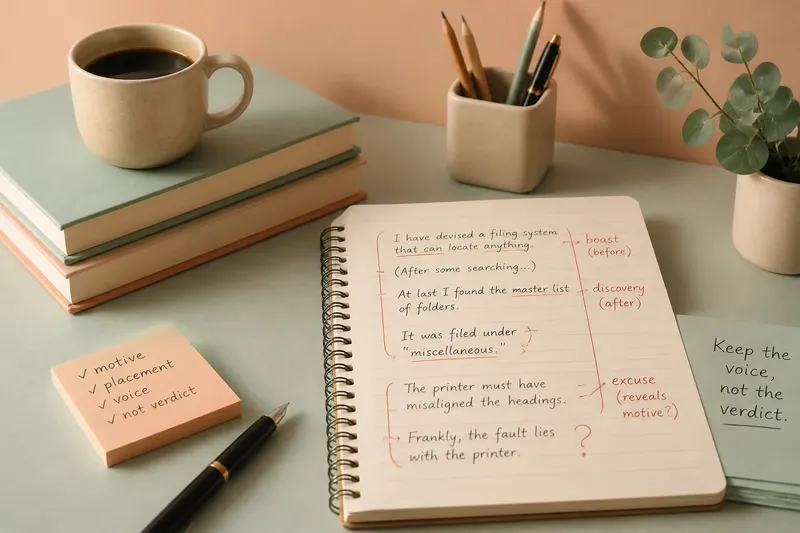
Say you are revising a paragraph in which a narrator claims their new filing system can locate anything, then admits that the list of folders is filed under “miscellaneous”. The working material is the narrator’s boast, the misplaced list and a sentence blaming the office printer. First, keep the boast before the search because it establishes the speaker’s confidence. Next, place the discovery of the list after that claim, so the contradiction belongs to the scene. Then read the printer excuse aloud: if it sounds like this narrator’s familiar way of avoiding responsibility, retain it as a revealing response; if it merely tells the reader that the system is absurd, cut it. The resulting paragraph lets the narrator’s habits carry the comedy without an authorial verdict explaining the joke.
For a final pass, underline every sentence in which the narrator explains an action or corrects their own account. Ask what each sentence reveals about the speaker’s priorities, then adjust its position or remove it according to that answer. The main search question—when a narrator explains the joke—comes down to this: does the sentence let us hear the narrator more clearly, or only tell us what to think of the joke?